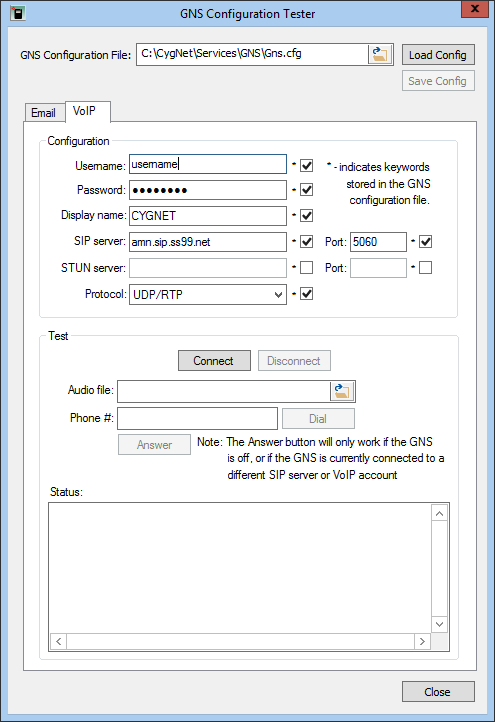
After setting up a VoIP/SIP account through your enterprise’s IT department or VoIP experts, use the VoIP page of the GNS Configuration Tester (GnsConfig.exe) to test SIP settings and save them to your Gns.cfg file. Configuring the Gns.cfg file to use SIP as its VoIP protocol allows the GNS to send Voice (text-to-speech) and WAV notifications, and to call into the GNS to acknowledge notifications.
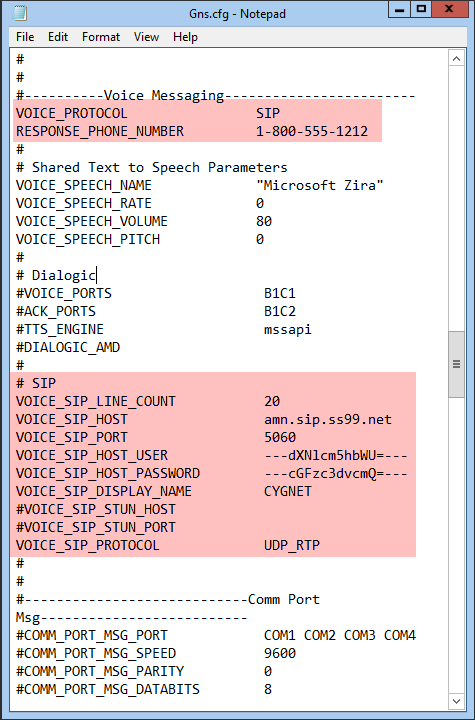
The VoIP page of the GNS Configuration Tester defines parameters for the voice messaging keywords in the GNS configuration file and allows users to modify the SIP settings in the Gns.cfg file. The page also provides a test feature to connect and interact with the specified SIP server.
For more information, see Configuring VoIP Properties.
The following is an example of the VoIP page of the GNS Configuration Tester dialog box with its corresponding GNS configuration file settings and other applicable properties:
|
|
|
The properties on the VoIP page of the GNS Configuration Tester dialog box are described here. These settings also can be changed using the Config File Manager.
Note: To configure your system to test VoIP in your specific environment, see your vendor-provided documentation.
To Configure the VoIP Properties in the GNS Configuration Tester Utility
-OR-
Note: The Audio file option only applies to the GNS Configuration Tester utility. It is not saved to the Gns.cfg file, and will not apply to calls placed to/from the GNS.
Note: If the selected audio file sounds distorted or sped up when played over the call, select a PCM WAV file with a higher sample rate.
Note: The Phone # option only applies to GNS Configuration Tester utility. It is not saved to the Gns.cfg file, and will not apply to calls placed to/from the GNS.
The following table includes properties on the VoIP page of the GNS Configuration Tester dialog box and their associated Gns.cfg file keywords (when applicable). Values displayed as "configurable" in the Value used for VoIP column are provided by the user or by your enterprise’s IT department or VoIP experts.
Note: The Dialogic section of the Gns.cfg file is not used for VoIP and is not included in the following table.
| GNS Configuration Tester Field | Gns.cfg File Keyword | Required for VoIP | Value used for VoIP | Description |
|---|---|---|---|---|
|
GNS Configuration File |
N/A |
Yes |
configurable |
The path to the associated GNS configuration file (Gns.cfg). |
|
Voice Messaging Section |
||||
|
N/A |
VOICE_PROTOCOL |
Yes |
SIP |
Voice messaging protocol. |
|
N/A |
RESPONSE_PHONE_NUMBER |
No |
configurable |
Can be appended to the notification voice message so that the user can know what number to call to acknowledge the notification. Optional field. |
|
Configuration section |
SIP |
|||
|
N/A |
VOICE_SIP_LINE_COUNT |
Yes |
configurable |
The number of simultaneous call lines allowed for the SIP client. Valid values: 1 to 2,147,483,647 |
|
Username |
VOICE_SIP_HOST_USER |
Yes |
configurable |
The user ID to register to the SIP host. Encrypted by utility. |
|
Password |
VOICE_SIP_HOST_PASSWORD |
Yes |
configurable |
The user password. Encrypted by utility. |
|
Display name |
VOICE_SIP_DISPLAY_NAME |
No |
configurable |
The display name to be made available to recipients for identification (e.g. caller ID) purposes. Optional field. |
|
SIP server |
VOICE_SIP_HOST |
Yes |
configurable |
The name of the host server providing SIP connection. |
|
Port |
VOICE_SIP_PORT |
Yes |
configurable |
The port used by the SIP host for SIP connections. |
|
STUN server |
VOICE_SIP_STUN_HOST |
No |
configurable |
The name of the host server providing STUN services for the SIP connection. Optional field. |
|
Port |
VOICE_SIP_STUN_PORT |
No |
configurable |
The port used by the STUN host for STUN services. Optional field. |
|
Protocol |
VOICE_SIP_PROTOCOL |
Yes |
UDP_RTP |
The SIP transport and media transfer protocols used by the SIP host for VoIP communications. Default is "UDP_RTP", which means that the SIP client will use UDP for SIP transport and RTP for media transfer. Note: "UDP_RTP" is the only available value. |
|
Test Section |
||||
|
Audio file |
N/A |
No |
configurable |
The path to the WAV file played by the SIP client when a call is placed or answered using the GNS Configuration Tester utility. Note: WAV files must be 8000Hz, 16000Hz, 32000Hz, or 48000Hz mono 16-bit PCM format. |
|
Phone # |
N/A |
No |
configurable |
The number that is dialed when the Dial button is clicked. If the phone number of the VoIP account for the connected SIP server/user is called, the Answer button is enabled, allowing a user to answer the call within the utility. |
|
Status |
N/A |
N/A |
Displays the status of the connection. |

|
|
|

